
How AI Is Transforming Outsourcing & Not Replacing It

AI in Outsourcing: Key Takeaways
- AI is not replacing outsourcing. It is changing what effective outsourcing looks like by removing friction and raising expectations for speed, quality, and accountability
- Here’s the kicker: AI on its own won’t save you. Pair it with the right team, though, and that’s where things start to click
- Outsourcing models built only around cost and headcount will fall behind. Performance, integration, and adaptability are becoming the new baseline
- AI works best when it supports people, not when it tries to replace them. Teams using AI intelligently move faster, make fewer mistakes, and focus on higher-impact work
- CoDev operates at the intersection of talent, automation, and outcomes. Their embedded teams, AI-enabled workflows, and U.S.-led oversight are built for how outsourcing works now and where it is going next
It’s the question echoing across boardrooms and strategy sessions, spoken aloud, scribbled in margins, quietly worried over.
Nearly 75% of companies say they struggle to find and retain skilled talent, at the same time AI tools are advancing faster than most organizations can absorb them.
It’s no surprise so many executives are asking the same question: Is AI replacing outsourcing?
Let’s face it: no one wants their best engineers buried in bug fixes or rewriting documentation for the fifth time. That’s where AI earns its keep, taking the grind out of the job.
But the real insight and decision-making? That still comes from people who’ve done this before.
In this article, we’ll break down:
- Where AI truly fits in outsourcing
- What it can and can’t automate
- Why the future belongs to companies that pair global talent with intelligent automation
Build teams that deliver, not just scale. Get started with CoDev.
The Big Question: Is AI Replacing Outsourcing?
This question isn’t coming out of nowhere.
AI tools are moving fast. Automation headlines are everywhere. At the same time, companies are under pressure to move faster, spend less, and do more with leaner teams.
In strategy meetings everywhere, the fear isn’t just about AI taking jobs. It’s about betting big on the wrong delivery model and paying for it later
They’re asking:
- Will tools replace people we’re paying for today?
- Are we building teams that could become obsolete?
- Is our outsourcing partner evolving or standing still?
AI doesn’t replace teams. It replaces tasks, the repetitive, manual work that slows delivery and adds little strategic value.
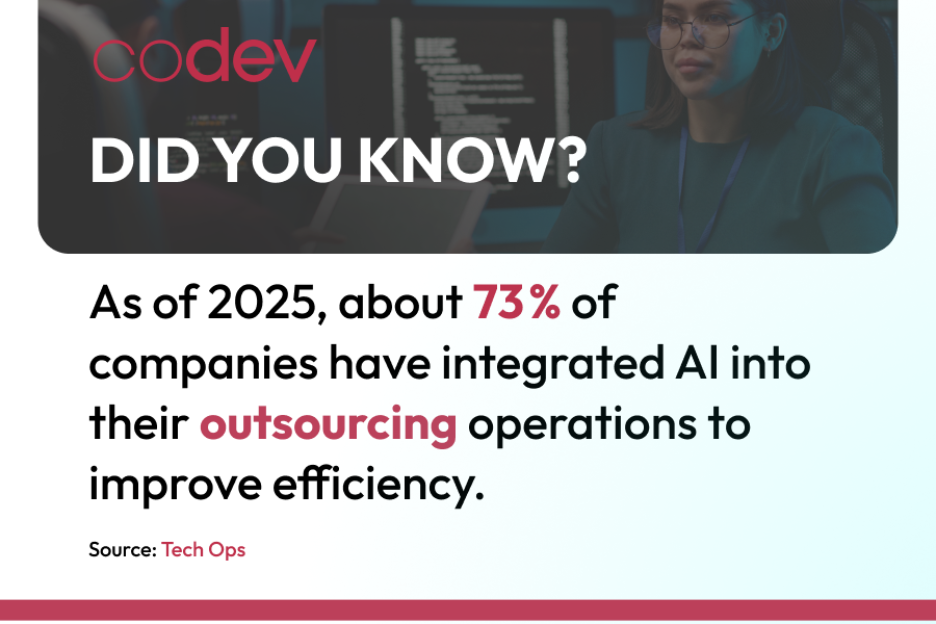
Outsourcing, on the other hand, has always been about capacity: expanding what your business can execute without overloading internal teams
How AI Supercharges an Offshore Development Team
The impact of AI becomes clearest when you look at how it changes everyday delivery for an offshore development team.
Before AI
In a traditional model, even high-performing teams spend too much time managing friction instead of moving fast:
- Manual testing slows release cycles and increases QA effort
- Slower releases as quality checks stack up late in the sprint
- Senior engineers tied up in code reviews and rework
- Limited visibility into performance, velocity, and bottlenecks
After AI Integration
When AI is applied intentionally to support (not replace) developers, the team operates very differently:
- AI-assisted QA and code review catch issues earlier
- Faster sprint cycles with fewer last-minute fixes
- Engineers focused on architecture, delivery, and product impact
- Clear performance metrics from day one, with ongoing visibility
It’s still the same team, but now they’re moving faster, catching issues earlier, and spending more time where it matters: on results.
The Truth: AI Is Not a Threat to Outsourcing, It’s a Multiplier
AI isn’t eliminating teams. It’s changing where value is created.
When used well, AI removes friction from the work that slows teams down: manual checks, repetitive tasks, and process-heavy execution.
This shift is changing the role outsourcing plays inside modern organizations.
Outsourcing is moving away from execution-only support and toward outcome ownership. It’s no longer about adding headcount to get work done. It’s about improving performance: delivering faster, more reliably, and with fewer mistakes.
When global teams are paired with AI, the results compound:
- Delivery cycles shorten as automation handles repetitive work
- Error rates drop with AI-assisted quality checks and reviews
- Senior talent spends less time on low-leverage tasks and more time on decisions that move the business forward
Why the Winning Model Is Global Talent + AI, Not One or the Other
The companies pulling ahead aren’t debating whether to use AI or offshore teams. They’re redesigning how work gets done by combining both, intentionally and strategically.
What AI Does Best: Removes Friction and Increases Speed
AI excels at handling the repetitive, time-consuming work that slows teams down. Organizations are beginning to see this in real terms:
- In 2025, 88% of companies reported regular AI use in at least one business function, up sharply from the year before, showing how pervasive automation is becoming in everyday work
- Around 83% of outsourcing teams are integrating AI in some part of their service delivery, marking a clear trend toward “AI-powered outsourcing.”
- Separate research indicates AI adoption correlates with measurable productivity increases, leaders frequently cite efficiency improvements as primary goals of their AI initiatives
What Global Talent Does Best: Owning Outcomes and Context
You can hand off the busywork to a machine, but when priorities shift or risk shows up? You still need experienced people who can think fast and steer.
- Automation accelerates execution, but human judgment resolves ambiguity, prioritizes trade-offs, and manages risk... capabilities AI doesn’t reliably replicate
- Real-world adoption research shows that although AI use is widespread, many organizations struggle to scale AI value without human-centric governance and integrated workflow redesign
This is where value compounds, when teams aren’t just executing tasks, but owning results.
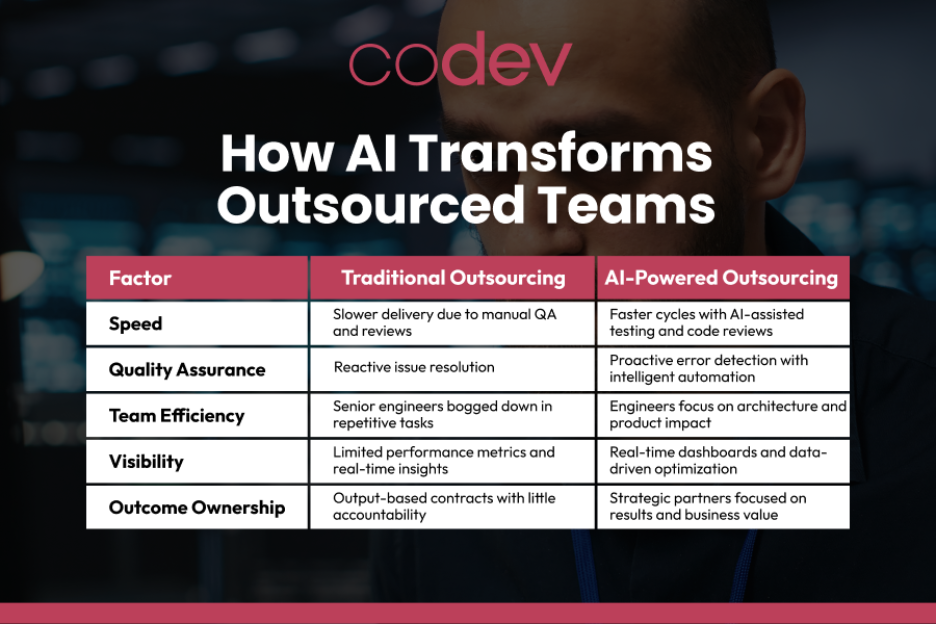
Comparing traditional and AI-powered outsourcing models: key differences in speed, quality, efficiency, visibility, and outcome ownership
Why the Combination Outperforms Either Alone
When global teams are paired with AI, performance improves across the board. Emerging evidence explains why:
- AI frees skilled workers from repetitive tasks, allowing them to focus on higher-order decisions, planning, and oversight, the areas of work with the most strategic payoff
- Organizations that combine automation with human expertise are better positioned to harness innovation and maintain operational resilience, a primary goal cited by most AI adopters.
- The move toward hybrid models that blend human teams and automation is reflected in industry outsourcing surveys showing significant AI uptake across outsourced services.
AI amplifies what strong teams already do well. Teams give AI direction, context, and responsibility.
Why Outsourcing Alone Will Not Be Enough in 2026
As automation becomes baseline infrastructure, not a novelty, outsourcing models built purely around labor and cost savings will struggle to keep pace. Modern expectations demand partners who can:
- Drive measurable outcomes, not just deliver bodies
- Integrate AI into workflows intelligently, not treat it as extra tooling
- Scale performance as business needs evolve
The right team changes everything. Build your team with CoDev.
Why CoDev Is Built for the Future of AI-Powered Outsourcing
AI is reshaping how outsourcing works, but success depends on execution, not tools alone. CoDev was built for this hybrid model from the start, combining global talent, intelligent automation, and accountability into a single operating approach.
What sets CoDev apart is not just access to technology, but how it is applied in real delivery environments.
CoDev’s core advantages include:
- AI-enabled talent matching and delivery that improve speed, precision, and role fit
- Embedded global teams that integrate with your tools, processes, and culture
- U.S.-led oversight with physical offshore offices, ensuring security, compliance, and clear communication
- Retention built into the model, with teams that stay significantly longer than offshore norms
- Measurable performance from day one, with clear metrics tied to business outcomes
- Outcome ownership, not transactional staffing or short-term placements
AI will not replace outsourcing. It will redefine it.
We also provide services across:
Results matter more than headcount. Explore CoDev success stories.
About AI and Outsourcing: FAQs
Will AI replace outsourced workers?
No. AI replaces specific tasks, not entire teams. It is best used to automate repetitive, manual work such as testing, data processing, and documentation. Outsourced teams still provide judgment, accountability, problem-solving, and execution ownership. The most effective companies use AI to support outsourced teams, not eliminate them.
Is outsourcing still relevant in the age of AI?
Yes. Outsourcing is becoming more relevant, not less. As AI accelerates delivery expectations, companies need skilled global teams who can integrate AI into workflows, manage complexity, and deliver outcomes. Outsourcing models that combine talent with automation are outperforming traditional labor-only approaches.
How does AI improve offshore development teams?
AI improves offshore development teams by increasing speed, consistency, and visibility. Common benefits include faster testing cycles, earlier issue detection through AI-assisted code reviews, reduced rework, and clearer performance metrics. This allows engineers to focus on architecture, delivery, and product impact instead of repetitive tasks.
What tasks can AI automate in outsourced teams?
AI can automate or assist with tasks such as:
- Software testing and QA
- Code reviews and refactoring support Documentation and reporting
- Data validation and cleanup
- Ticket triage and workflow routing
What tasks cannot be replaced by AI in outsourcing?
AI cannot replace responsibilities that require human judgment and accountability, including system architecture decisions, security oversight, stakeholder communication, prioritization, and cultural alignment. These are core areas where experienced outsourced teams create long-term value.
Should companies change their outsourcing strategy because of AI?
Yes. Companies should evolve their outsourcing strategy to include AI as part of delivery, not as a separate tool. This means choosing partners who integrate AI into workflows, upskill teams continuously, and take responsibility for outcomes rather than just providing headcount.
What is AI-powered outsourcing?
AI-powered outsourcing refers to a delivery model where global teams use AI to automate low-value tasks, improve quality, and increase speed while humans focus on strategy, execution, and results. It combines global talent, intelligent automation, and performance accountability into one operating model.
How do I know if my outsourcing provider is keeping up with AI?
Key indicators include whether your provider actively integrates AI into delivery, provides clear performance metrics, upskills teams regularly, and can explain where AI should and should not be used. Providers that rely solely on manual processes or cost-based staffing models may struggle to keep pace.
Move faster without losing control. Build your team today.