

Staff Augmentation Explained: How It Works, When to Use It, and How to Choose a Partner
Staff augmentation is a way to add skilled professionals to your existing team on a flexible basis, where the people you bring on work as an extension of your in-house staff rather than as an outside vendor running a separate project. It solves a problem most engineering and operations leaders know well: permanent hiring takes too long, freelancers rarely stick around, and offshore arrangements carry a reputation for uneven quality.
This guide explains what staff augmentation is, how it differs from outsourcing and managed services, when it makes sense to use, the offshore, nearshore, and onshore models available, and how to choose a partner that delivers. Where it helps, you can see the roles CoDev places to ground the model in real examples.

What is staff augmentation?
Staff augmentation is a staffing model where a company hires external professionals to fill specific roles on its existing team, keeping full control over the work while the partner handles recruiting, employment, and infrastructure. The staff augmentation meaning is straightforward: you augment your own staff with vetted people who report to your managers and follow your processes, instead of handing an entire function to a third party. You will also see it called team augmentation, resource augmentation, or simply staff aug; the older phrase "resource and staff augmentation" describes the same arrangement.
How staff augmentation works
You define the roles and skills you need. A staff augmentation partner sources, vets, and presents candidates. You interview and select, the same way you would for a direct hire. The selected professionals join your team, work in your tools and workflows, and take direction from your leads. The partner remains the legal employer and handles payroll, benefits, and HR, which is what separates this model from hiring a full-time employee or engaging an independent contractor directly.
Who uses it
Staff augmentation is used across company sizes, from early-stage startups filling a single specialized gap to enterprises scaling a department for a product push. It is common in software, but the model applies anywhere skilled roles are hard to hire quickly: data, security, customer support, operations, and go-to-market functions all use it. Industries with seasonal demand or project-based work, such as fintech, healthcare technology, and SaaS, tend to rely on it most.
The market reflects that demand. Staffing Industry Analysts put the global staffing market at roughly $620 billion in 2024, and the American Staffing Association reports that U.S. staffing companies provided jobs for about 11 million people in 2024, with around 2.2 million temporary and contract workers employed in an average week. The U.S. Bureau of Labor Statistics tracks the same temporary-help workforce as a standing part of the economy. This is not a niche workaround; it is how modern teams scale.
What is IT staff augmentation specifically?
Apply the same model to technical roles and you get IT staff augmentation, also called technology staff augmentation, technical staff augmentation, or engineering staff augmentation: developers, engineers, and other specialists added to your team without becoming permanent hires. It is the most common form, because technical talent is the hardest to recruit, slowest to onboard, and costliest to lose.
The roles filled this way usually include software developers across web and mobile, DevOps and cloud engineers, QA and test engineers, data engineers, and increasingly AI and machine learning specialists. These are skills where demand outpaces local supply, so teams reach outside their own market to fill them. For a fuller view of what these engagements cover, see our software delivery services.
The model is not limited to engineering. The same approach works for operations and customer support and go-to-market roles, which matters for companies that want one partner across several functions rather than a separate arrangement for each.
Staff augmentation vs outsourcing vs managed services
The short answer: with staff augmentation you keep day-to-day control and own the outcome; with outsourcing and managed services you hand more of both to the provider. The right choice depends on how much control you want to keep and who you want accountable for results.
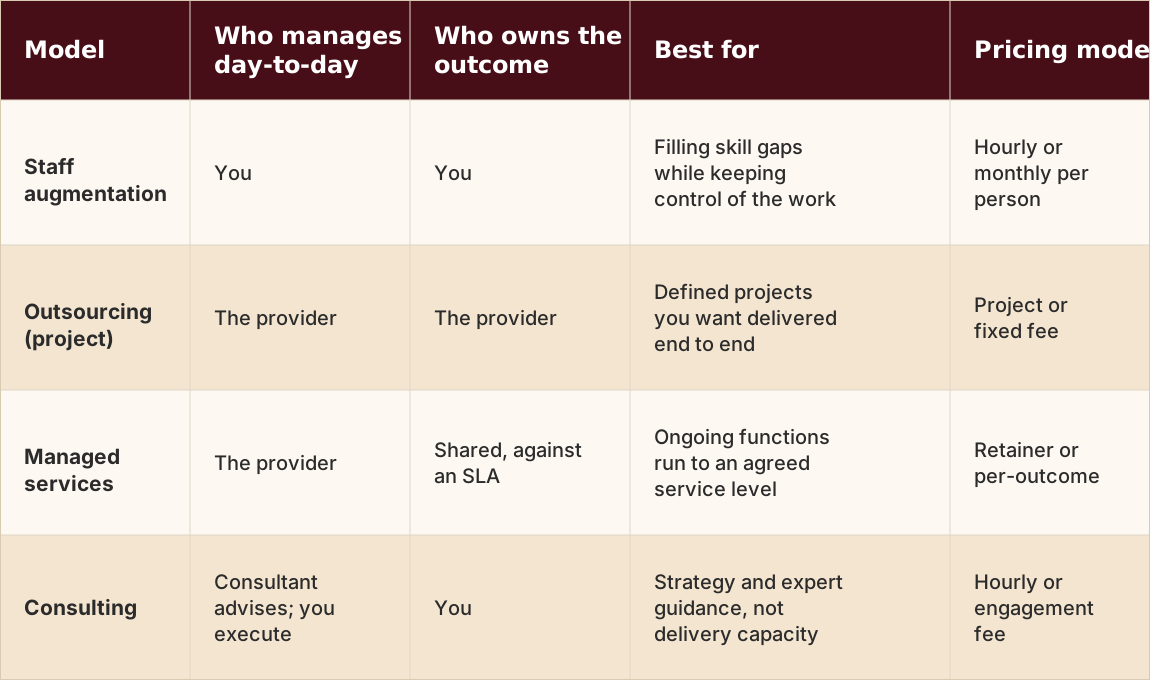
Staff augmentation vs outsourcing usually comes down to control. Outsourcing is the better fit when you have a clearly defined deliverable and would rather not manage the people doing it. Staff augmentation fits when the work is ongoing or evolving and you want the added people inside your own process. Staff augmentation vs managed services is a similar trade: managed services suit a function you want run to a service level with minimal involvement, while augmentation keeps the function in your hands. For the full breakdown of the first comparison, see our guide to staff augmentation vs outsourcing.
When should you use staff augmentation?
Use staff augmentation when you need specific skills or added capacity quickly and want to keep control of the work. These are the situations where it fits best:
Scaling fast without permanent headcount. You need to grow output now but are not ready to commit to full-time hires and the cost that comes with them.
Filling a specialized skill gap. A project needs AI/ML, security, or a specific stack your team does not have, and hiring for it directly would take months.
Time-bound projects. The work has a defined end date, so adding permanent staff would leave you overstaffed once it ships.
A hiring freeze on permanent roles. Budget rules block new full-time positions, but contract capacity is still available.
Geographic expansion. You want talent in a new region without setting up a legal entity there.
Covering extended absence. Parental leave or a long absence creates a temporary gap you need filled by someone who can integrate quickly.
Burst capacity. A product launch or regulatory deadline needs more hands for a defined window.
Cutting time-to-hire. Direct hiring can run 90 days or more. Augmentation can bring vetted people on in under 30.
Models of staff augmentation: offshore, nearshore, onshore

Staff augmentation comes in three location models, and the right one depends on your priorities across cost, time zone overlap, communication, and how deep a talent pool you need. Each involves a trade.
Onshore staff augmentation
Onshore means the augmented staff are in the same country as you. The advantages are full time zone overlap and no language or cultural distance. The trade-off is cost: onshore talent is the most expensive of the three models, and in tight markets it can be as hard to source as a direct hire.
Nearshore staff augmentation
Nearshore means a nearby country, usually within a few hours of your time zone. You get most of the working-hours overlap of onshore at a lower cost. The talent pool is smaller than offshore markets, so highly specialized skills can be harder to find.
Offshore staff augmentation
Offshore means a more distant country, and it brings the deepest talent pool and the lowest cost of the three. The Philippines is one of the strongest offshore markets for technical and operational talent, with a large English-speaking workforce and a deep developer base, which is why it anchors CoDev's model. The real variable with offshore is not quality, it is management: time zone and communication only become problems without structure. With a partner running onboarding, coaching, and a single point of contact in your time zone, an offshore team works as a direct extension of your staff. For more on the upside, see our take on offshore software development.
How to choose a staff augmentation partner
Most providers look the same in a sales call, whether they call themselves a staff augmentation firm, an agency, or a partner. The differences show up in how they answer a few specific operational questions, and two of them predict a bad engagement more reliably than the rest: how they vet, and how long their people stay. Start there.
Ask exactly how candidates are assessed. A wrong hire is not a neutral event; it is two or three months of a lead's time spent managing someone who never ramps, plus the re-hire that follows. A serious partner uses technical assessments, language testing, and expert interviews, and screens out most applicants rather than passing through whoever is available. At CoDev, candidates go through Codility technical assessments, TrueNorth language testing, and expert interviews, with roughly a 30% pass rate. Weak partners skip these steps and let you discover the gaps after the person starts.
Ask for the partner's average tenure. The industry standard runs 12 to 18 months, so a partner with high churn keeps handing you new people to onboard, and every handoff resets the continuity you are paying for. CoDev's retention runs about 2.5 times the industry average, which means less churn, less re-onboarding, and more continuity on your work.
Ask who owns ramp-up and how fast people reach productivity. A partner with a real onboarding practice gets people contributing in weeks; CoDev reports that 95% of placed staff reach productivity within 60 days.
Ask where people actually work. A team in a secure office with redundant connectivity is a different proposition from a team working off a single home internet line. CoDev's offices are SOC 2 certified with dual internet and backup power.
Ask whether you get a single point of contact in your time zone or whether you file tickets and wait. CoDev pairs every client with a U.S.-based Customer Success Manager who owns the relationship.
Ask what happens if a placement does not work out. Look for a replacement-or-refund window, clear SLA terms, and reasonable exit terms. CoDev backs placements with a 30-day fit guarantee: if the person is not right in the first 30 days, they are replaced or you are reimbursed.
Confirm SOC 2, GDPR where relevant, and any country-specific data protection that applies to your work.
Be cautious with partners who cannot give you a number without a long discovery call. For the detail on how CoDev vets and onboards, read about how we vet and onboard.
How staff augmentation works step by stept
The process moves from defining the gap to managing an integrated team member, usually across four to five stages. Here is how it runs with a structured partner.
Assessment. You define the gap, the role, the skills required, and how the person fits your team. The partner turns your job description into a candidate profile.
Candidate matching and review. The partner sources and screens against that profile and presents a shortlist of vetted candidates for you to review.
Interviewing and selection. You interview the shortlist and choose, the same as you would for a direct hire. You make the final call.
Onboarding and integration. The selected person joins your tools, processes, and workflows. The partner handles the ramp-up so they start contributing quickly.
Ongoing management and performance. You manage the work day to day. The partner supports the person through coaching and a dedicated point of contact, and handles employment, payroll, and HR.
This mirrors how CoDev's own process runs, from pre-screening and matching through interviews and post-hire support. Our approach to building offshore teams walks through what happens at each stage.
Cost of staff augmentation
Most of what you pay comes down to one choice: where the talent sits. Staff augmentation is priced per person, hourly or monthly, and the location model drives the rest. Some partners also offer project-based pricing for defined scopes.
Cost ranges track the three models. Onshore is the most expensive, nearshore sits in the middle, and offshore is the lowest. A useful reference point: hiring offshore in a market like the Philippines can run roughly 60 to 70% below the cost of an equivalent in-house hire in the United States, once you account for salary plus benefits and overhead.
When you compare quotes, check what is included. A per-person rate from a structured partner typically covers recruiting, employment and payroll, benefits, secure office infrastructure, and ongoing coaching and account management. A lower headline rate that excludes those costs is not actually cheaper once you add them back. For a transparent breakdown of what a team would cost, get a custom team plan.
Common pitfalls to avoid
Most staff augmentation engagements that go wrong fail for predictable reasons. These are the ones to watch for:
Choosing the cheapest provider without checking infrastructure. A low rate often means home offices, single internet lines, and no security certification. You pay for that later in downtime and risk.
Treating augmented staff like freelancers. The model works when people are integrated into your team's processes and tools, not held at arm's length.
Skipping onboarding to save time. Cutting ramp-up to start faster usually slows everything down, because the person never fully integrates.
No clear success metrics. Without defined KPIs, you cannot tell whether the engagement is working until it is too late to adjust.
Choosing nearshore on cost alone. Offshore with structured management often delivers better outcomes for the price than nearshore chosen only to save money.
Not asking about retention. A partner with high churn will keep handing you new people to onboard, which erodes the continuity that makes the model work.
The takeaway
A quick recap:
Staff augmentation adds vetted people to your team while you keep control of the work.
It differs from outsourcing and managed services, which hand day-to-day control to the provider.
Offshore, nearshore, and onshore models trade cost against time zone overlap and talent depth.
Vetting rigor and retention tell you more about a partner than the location model does. Ask for pass rates and average tenure before you ask about price.
Used well, staff augmentation is less a stopgap than a workforce strategy: a way to keep the right skills on your team exactly when you need them.
Ready to see what staff augmentation looks like in practice? Get a custom team plan in 48 hours.
Frequently asked questions
What is the difference between staff augmentation and outsourcing?
With staff augmentation, you add people to your team and manage their work directly while keeping ownership of the outcome. With outsourcing, you hand a defined project to a provider who manages the people and delivers the result.
How much does staff augmentation cost?
It is usually priced per person, hourly or monthly, and depends on location. Offshore hiring in a market like the Philippines can run roughly 60 to 70% below an equivalent U.S. in-house hire once benefits and overhead are included.
How fast can you ramp up an augmented team?
A structured partner can present vetted candidates and place people in under 30 days, compared with 90 days or more for direct hiring. Onboarding then brings them to productivity within weeks.
Do augmented staff work in our systems and tools?
Yes. Augmented staff work inside your tools, processes, and workflows and take direction from your managers. That integration is what separates the model from arms-length outsourcing.
Can I scale my augmented team up or down?
Yes. You can add roles as work grows and reduce the team as projects end, which is one of the main reasons companies choose the model over permanent hiring.
What roles can be filled with staff augmentation?
Common roles include software developers, DevOps and cloud engineers, QA, data engineers, and AI/ML specialists, along with operations, customer support, and go-to-market roles.
Is offshore staff augmentation secure?
It can be, with the right partner. Look for SOC 2 certified offices, secure connectivity, and clear data protection terms rather than staff working from unsecured home setups.
Who manages the day-to-day work of augmented staff?
You do. Augmented staff report to your managers and follow your processes. The partner handles employment, payroll, HR, and ongoing coaching in the background.